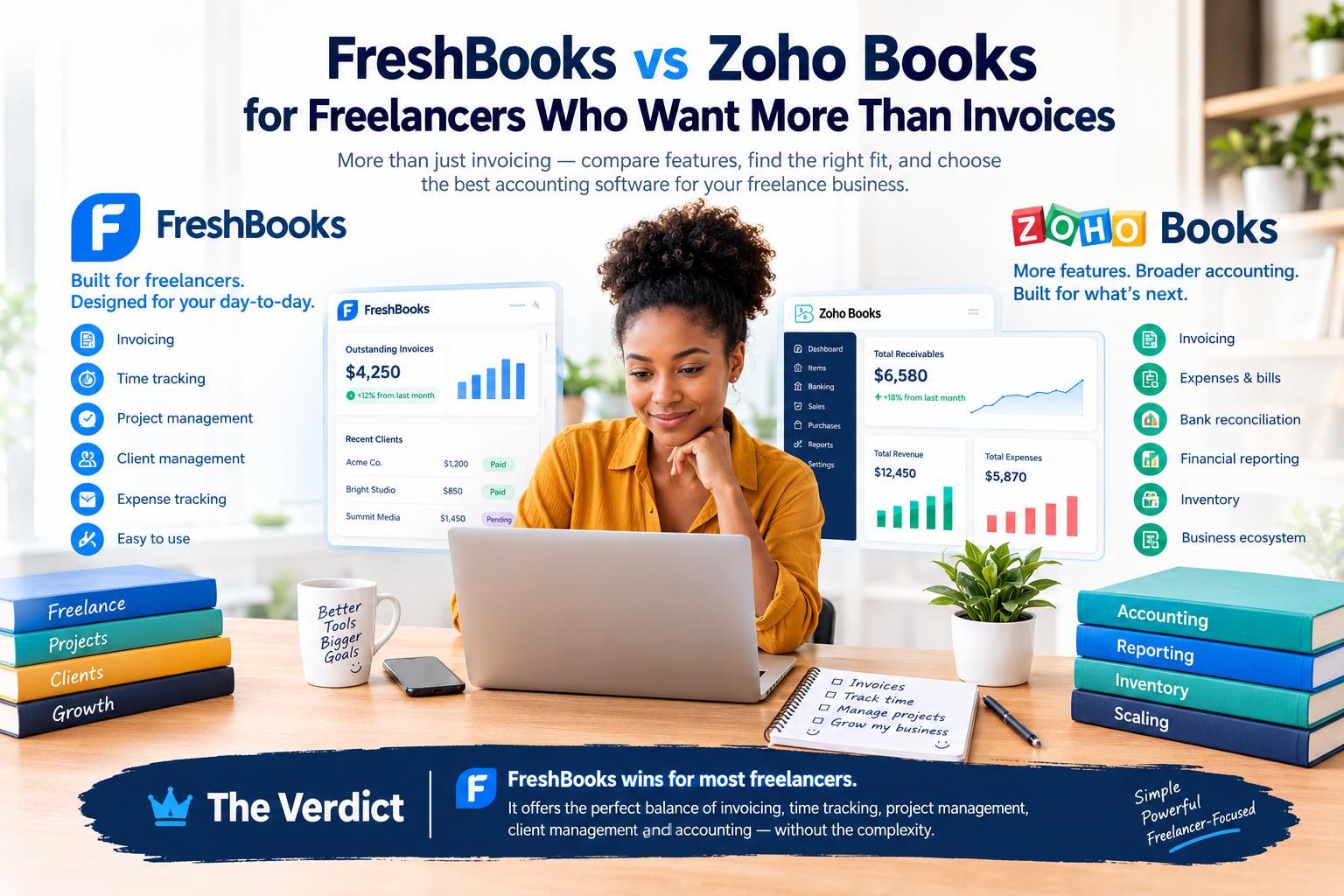
For freelancers, accounting software often starts with a straightforward goal: send professional invoices, track payments and get paid on time.
But a successful freelance business quickly becomes more complicated.
You may need to track expenses, record billable hours, monitor project profitability, reconcile bank transactions, prepare financial reports and stay on top of taxes. At that point, an invoicing tool alone is no longer enough.
That puts two popular cloud accounting platforms—FreshBooks and Zoho Books—on the shortlist.
Both offer considerably more than basic invoicing. However, for freelancers and independent professionals, FreshBooks has a particularly strong advantage: it combines accounting with client, project and time-management workflows in a way that feels purpose-built for service businesses.
Zoho Books may offer broader accounting capabilities in some areas, but FreshBooks can be the more natural choice for freelancers who want to grow without turning financial administration into a full-time job.
Why FreshBooks Makes Sense for Freelancers
FreshBooks was built around a fundamental reality of freelance work:
Your clients are your business.
A freelancer doesn't simply record accounting transactions. They manage projects, communicate with customers, track hours, create invoices and follow up on payments.
FreshBooks brings many of those activities together.
Instead of moving between a time-tracking app, spreadsheet, invoicing tool and accounting platform, freelancers can manage much of the workflow within one environment.
That can be particularly valuable for:
Writers
Designers
Developers
Consultants
Photographers
Marketing professionals
Coaches
Independent contractors
Agencies and small service businesses
More Than an Invoicing Platform
Calling FreshBooks an invoicing application undersells what the platform can do.
Its broader functionality includes areas such as:
Invoicing
Estimates
Payments
Expense tracking
Time tracking
Projects
Client management
Financial reporting
Accounting
Recurring billing
Automated workflows
The result is a workflow that can look like this:
Track time
↓
Manage project
↓
Create invoice
↓
Receive payment
↓
Record transaction
↓
Review profitability
For a freelancer, that's a much more useful proposition than simply generating a PDF invoice.
freshBooks' Biggest Advantage: Time Tracking
For many freelancers, time is inventory.
A consultant who bills $100 per hour isn't selling a physical product. Their primary asset is expertise and time.
That makes accurate time tracking extremely important.
FreshBooks integrates time tracking with its broader client and billing workflow, making it easier to turn recorded work into billable amounts.
Consider a freelancer who unintentionally fails to bill five hours each month:
Monthly Unbilled TimeHourly RatePotential Revenue Lost2 hours$50$1005 hours$75$37510 hours$75$75010 hours$100$1,00020 hours$100$2,000
Over a year, those missed hours can become substantial.
That's why time tracking isn't merely an administrative feature.
It can directly affect revenue.
Client Management Is Another FreshBooks Strength
Freelancers often have a different relationship with accounting software than larger corporations.
For a large company, accounting may revolve around departments, purchase orders, inventory and complex financial controls.
For a freelancer, the workflow often starts with:
Who is the client? What work am I doing? How much have I billed? Have they paid?
FreshBooks' client-oriented approach fits this model particularly well.
A freelancer can keep financial activity connected to client work rather than treating accounting as an entirely separate administrative function.
Zoho Books: A Serious Alternative
None of this means Zoho Books is a weak competitor.
Quite the opposite.
Zoho Books is a capable cloud accounting platform with features covering areas such as:
Invoicing
Expenses
Bills
Banking
Reconciliation
Financial reporting
Tax-related accounting
Inventory
Customer and vendor management
Automation
Integrations
Its biggest advantage is breadth.
For a business that is moving beyond freelancing into a more complex operation, that broader accounting functionality can become increasingly valuable.
FreshBooks vs Zoho Books: Where Each Platform Wins
Category Winner Why Freelancer experience FreshBooks Designed around independent professionals Invoicing FreshBooks Strong client and billing work flow Time tracking FreshBooks Particularly well suited to billable work Project management FreshBooks Strong connection between projects and billing Ease of use FreshBooks Accessible for non-accountants Core book keeping Zoho Books Broad accounting capabilities Inventory Zoho Books Better suited to product-based businesses Business ecosystem Zoho Books Extensive Zoho application ecosystem Scalability Zoho Books Strong for increasingly complex businesses Freelancer-focused workflow FreshBooks Strong alignment with service professionals
When FreshBooks Is the Better Choice
FreshBooks makes particularly strong sense when your business revolves around services rather than products.
Imagine you're a freelance designer.
You have:
12 clients
Several active projects
Hourly and fixed-price work
Recurring monthly clients
Business expenses
A few subcontractors
Your financial workflow is likely to revolve around:
Projects → Time → Clients → Invoices → Payments
FreshBooks fits this model naturally.
The platform doesn't require you to think like an accountant before you can use it effectively.
That's an important advantage for someone whose actual profession is design, consulting, writing or development—not bookkeeping.
Where Zoho Books Has the Advantage
Zoho Books becomes increasingly attractive when accounting complexity takes center stage.
For example, imagine the same freelancer has evolved into a small agency with:
Employees
Contractors
Inventory
Multiple vendors
More complex expenses
Several business applications
More sophisticated financial reporting requirements
At that point, broader accounting functionality may matter more than the simplicity of a freelancer-focused workflow.
Zoho's wider business ecosystem can also be attractive to companies already using other Zoho products.
What About Pricing?
Price should be considered carefully with both platforms because plans, features, limits and availability can change—and pricing can differ by country.
Instead of asking:
Which subscription is cheaper?
Freelancers should ask:
Which platform gives me the greatest value for the work I actually need to do?
For example, if FreshBooks saves a freelancer several hours of administrative work every month and helps capture billable time, its subscription cost may be relatively small compared with the revenue and time it helps protect.
FreshBooks for the Freelancer Who Wants to Grow
A common misconception is that choosing a freelancer-oriented platform means choosing software that cannot support growth.
That's not necessarily true.
A freelancer can gradually evolve into:
Freelancer → Solo professional → Consultant → Small agency → Growing service business
The accounting requirements become more complex at every stage.
FreshBooks can accommodate many service-business workflows while maintaining an approachable user experience.
For a freelancer, that balance can be more valuable than having every conceivable accounting feature.
Which One Should You Choose?
Choose FreshBooks if you:
Work primarily with clients.
Sell professional services.
Bill by the hour or project.
Need strong time tracking.
Manage multiple client projects.
Want simple, professional invoicing.
Prefer an easy-to-use interface.
Don't want accounting software to feel unnecessarily complicated.
Choose Zoho Books if you:
Need broader accounting functionality.
Manage inventory.
Operate a more complex business.
Already use Zoho applications.
Need a wider business software ecosystem.
Expect your accounting requirements to become significantly more sophisticated.
The Verdict: FreshBooks Wins for Most Freelancers
Zoho Books deserves serious consideration, particularly for freelancers who are evolving into larger businesses or need more extensive accounting and inventory functionality.
But for the typical freelancer who wants more than invoices, FreshBooks has a compelling advantage.
Its combination of invoicing, time tracking, project management, expenses, client management and accounting reflects the way independent professionals actually work.
The most important question isn't how many features an accounting platform has.
It's whether those features fit your business.
For a freelancer whose business revolves around clients, projects, billable hours and getting paid, FreshBooks offers a particularly compelling combination of simplicity and functionality.